

Abstract
Objective
Typhoid fever is a grave and highly contagious illness caused by Salmonella typhi that is primarily spread through mucosal exposure to bacteria typically found in the gastrointestinal tract. his study focused on identifying the causes of the epidemic, predicting which populations are more susceptible to the disease, and evaluating the effectiveness of health measures set in place to prevent its spread in the Nineveh province.
Material and Methods
The study focused on patient data collected between 2018 and 2022. The count of infected individuals belonging to the sick group was authenticated based on the clinical diagnosis and laboratory investigation. Ultimately, we used a statistical analysis tool with SPSS version 25.
Results
The highest number of cases was registered on the left side of Mosul, followed by cases spreading to Shekhan, Hamdaniya, and Baaj, in that order. The main proportion of the cases was among 15-45 years and older than of 45 years old people with a relatively high correlation coefficient of (p<0.01).
Conclusion
The major reason for the spread of typhoid is the combination of poor quality of life and improper activities of the health system, which eventually lead to serious public health conditions. Strengthening the health-care system and raising public awareness about the disease are the two most crucial steps to slow down the outbreak.
Keywords: Health, Salmonella typhi, typhoid
What is known on this subject?
Typhoid is regarded as one of the most serious epidemic illnesses in nations with poor economies, and it may spread quickly, causing both physical and economic harm in society.
What this study adds?
Determining the breadth of the disease’s dissemination and increasing health and treatment knowledge in society may help reduce the number of potential infections.
Introduction
Typhoid fever is an infectious disease caused by the bacterium Salmonella typhi that is acquired through the ingestion of infected food or water. The illness is often reported to develop gradually over days, leading to persistent fever, severe headaches, and anorexia. In advanced cases, pink spots may infiltrate the abdomen while the abdomen may become distended due to splenomegaly. Patients may also complain of abdomen discomfort with constipation or diarrhea (, ).
Medical management has improved over the years, but typhoid still poses a health challenge in areas that lack sanitary conditions and adequate health education, and this includes most regions of Iraq. Salmonella typhi is thought to have a high prevalence in Iraq due to poor food and water hygiene, highly populated areas, and lack of knowledge about the importance of hand washing and the need to eat cooked food. Deafness, intestinal bleeding, and bowel perforation are some of the complications of typhoid that are associated with grave consequences (, ). In that regard, primary prevention measures include improvement of the sanitation facilities, provision of clean potable water, dissemination of health education and promotion and vaccination for typhoid fever ().
Typhoid finds a fertile ground particularly among the poorer and slum areas since these conditions tend to facilitate its transmission. Lack of basic sewage systems, contamination of groundwater, and lack of proper health care facilities enhance the risk of acquiring the disease. Moreover, the concentration of people in these areas enhances the chance of one infected person transmitting the disease to others hence; controlling the disease turns out to be a problem (, ).
Typhoid is generally treated by means of antibiotics. These agents destroy the pathogens of this sickness, and hence lessen the symptoms and the time these symptoms present. Apart from the antibiotics medication, the patient needs supportive treatment such as and intravenous fluids to combat dehydration and anti-pain and fever drugs (, ). In very severe cases, the patient needs to be hospitalized so that their status can be assessed and appropriate treatment given. Ceftriaxone is a broad-spectrum antibiotic that treats a variety of bacterial illnesses, including typhoid. Trimethoprim-sulfamethoxazole, on the other hand, is a combination antibiotic used to treat salmonella, although bacterial resistance is becoming increasingly widespread (, ).
Focusing on the prevention of typhoid is always better than the treatment of the disease. It is thus vital to seek measures that will help minimize such an outbreak, for instance, improving sanitary conditions, providing safe drinking water and promoting hygiene and sanitation education (, ).
However, a significant obstacle in the treatment of typhoid fever is the increase in bacterial types resistant to antibiotics. Probiotic bacteria and vaccinations are examples of new and effective therapies now being investigated in an effort to reduce the need for antibiotics and reduce the likelihood of antibiotic resistance. Current research further emphasizes the need for rapid diagnosis and treatment of typhoid patients, as this improves the prospects for recovery and reduces the risk of sequelae (, , ).
The goal of this study was to examine the incidence of typhoid in Nineveh province during the last five years and establish effective methods to minimize its spread. The illness prevalence was compared in Mosul and its districts.
Material and Methods
This work was conducted in compliance with the ethical approval granted by the College of Medicine, University of Mosul, under reference number [UOM/COM/MREC/2024()/1a] on 6th August 2024. Typhoid patients were identified based on an initial clinical diagnosis made by medical professionals based on a set of disease-specific clinical signs. Patient information was collected via the consent form contained in the supplement file. After verifying the clinical indications, a laboratory examination using the Widal test was performed to determine the presence of antibodies against the typhoid bacterium in the patient’s blood. The study sample includes all cases of typhoid confirmed clinically and in the laboratory in Nineveh province between 2018 and 2022. Gender, age, geographic area, clinical signs and symptoms, and laboratory test results were all acquired from patient records in hospitals and health clinics. Patients were categorized into five age groups: under 1 year, 1-4 years, 5-14 years, 15-45 years, and over 45 years.
Statistical Analysis
SPSS version 25 was used to conduct statistical analysis. A series of statistical tests was performed to identify parameters related with disease transmission and to assess changes in infection rates over time. The Anova test was performed to determine correlation coefficients between the variables.
Results
In this study, high peak cases occurred in 2021 and 2022, with no discernible difference in the number of infections between males and females. Infections are most typically observed among those aged 15-45 and the ages over 45, which are consistent with widely recognized recorded statistics.
Infections are less prevalent among children under the age of four. and show a significant correlation between infection rates, age groups (3rd and 4th), and genders at (p<0.01).
Table 1. Typhoid fever cases by age group and gender 2018-2022
Years | Below 1 year | 1-4 | 5-14 | 15-45 | Above 45 year | Total | Grand total | ||||||
|---|---|---|---|---|---|---|---|---|---|---|---|---|---|
M | F | M | F | M | F | M | F | M | F | M | F | ||
2018 | 0 | 0 | 15 | 31 | 188 | 158 | 953 | 1687 | 375 | 477 | 1531 | 2353 | 3884 |
2019 | 0 | 1 | 32 | 38 | 164 | 205 | 648 | 1240 | 276 | 210 | 1120 | 1694 | 2814 |
2020 | 0 | 2 | 13 | 12 | 104 | 142 | 608 | 1347 | 217 | 241 | 942 | 1744 | 2686 |
2021 | 0 | 0 | 19 | 42 | 189 | 225 | 837 | 1676 | 199 | 297 | 1244 | 2240 | 3484 |
2022 | 5 | 6 | 24 | 22 | 159 | 296 | 995 | 2013 | 339 | 598 | 1522 | 2935 | 4457 |
Total | 5 | 9 | 103 | 145 | 804 | 1026 | 4041 | 7963 | 1406 | 1823 | 6359 | 10966 | 17325 |
M: Male, F: Female
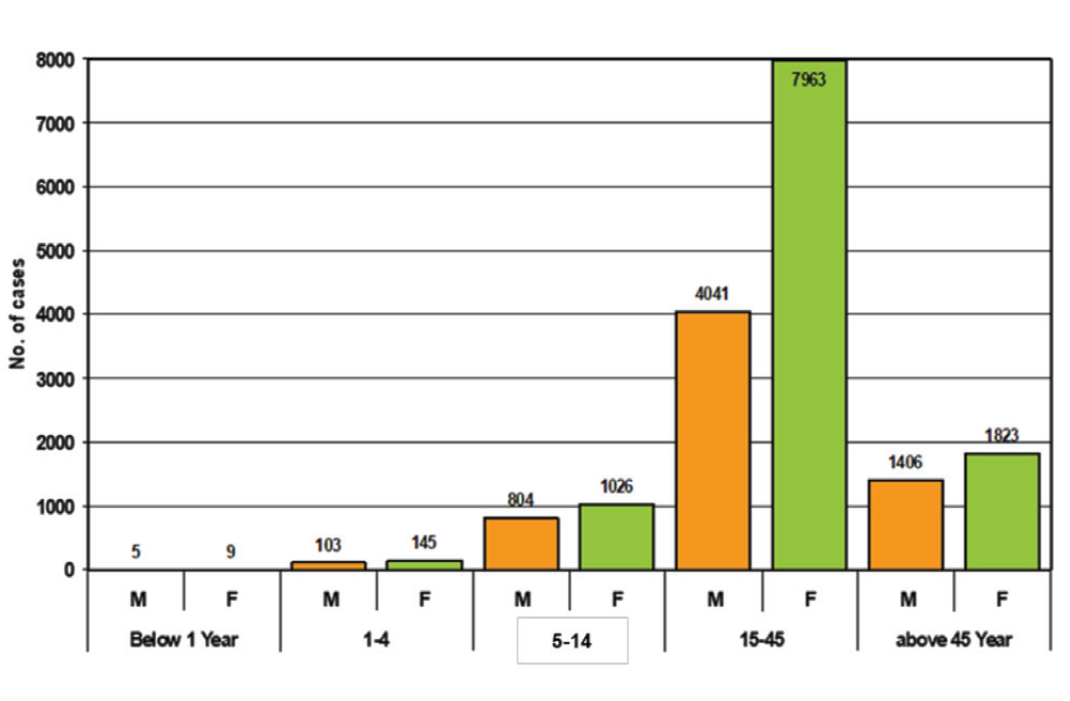
M: Male, F: Female
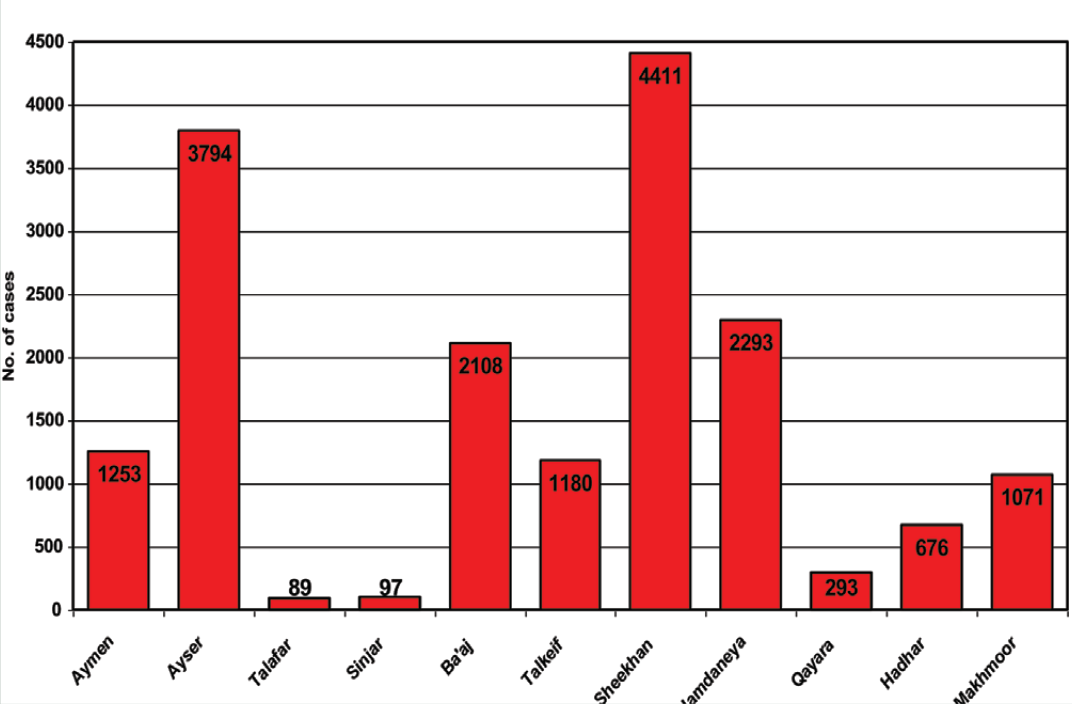
As demonstrated in the and , the largest occurrence rates were concentrated in Mosul city’s sectors (left) and Nineveh Governorate districts (Shekhan, Hamdaniya, and Baaj).
Table 2. Typhoid fever cases by district 2018-2022
Years | Aymen (Mosul right side) | Ayser (Mosul left side) | Talafar | Sinjar | Ba’aj | Talkeif | Sheekhan | Hamdaneya | Qayara | Hadhar | Makhmoor | Total |
|---|---|---|---|---|---|---|---|---|---|---|---|---|
2018 | 304 | 894 | 1 | 10 | 804 | 181 | 945 | 331 | 17 | 98 | 127 | 3712 |
2019 | 244 | 898 | 2 | 9 | 293 | 120 | 717 | 400 | 13 | 115 | 147 | 2958 |
2020 | 105 | 537 | 16 | 7 | 200 | 178 | 1033 | 263 | 0 | 115 | 232 | 2686 |
2021 | 288 | 630 | 0 | 4 | 247 | 377 | 1103 | 474 | 0 | 84 | 295 | 3502 |
2022 | 312 | 835 | 70 | 67 | 564 | 324 | 613 | 825 | 263 | 264 | 270 | 4407 |
Total | 1253 | 3794 | 89 | 97 | 2108 | 1180 | 4411 | 2293 | 293 | 676 | 1071 | 17265 |
Discussion
Typhoid is an endemic illness in Iraq, especially Nineveh province, as evidenced by the numbers indicated and documented, as well as statistics from prior years. The disease’s frequency fluctuates with population size. The incidence was assessed from 2018-2022. It was observed that oscillations in incidence rates are obvious.
According to the results of the study, however, this disease still remains a health problem among the people in Nineveh Governorate. Attack rates remain consistently high. Although the infection rates tend to have multiple wastages over time, however the years 2021 and 2022 reported the highest infection rates. The people that are majority in most risk groups are those within ages of 15 to 45 years, and that those above the age of 45 years were also at risk to the infection which is compatible with the previous report. Also the survey reported of Mosul and other areas of the governorate having unusually high number of infection cases, unlike other surveys. Such findings can be attributed to several factors which enhance the transmission of diseases such as poor sanitation facilities, pollution of water sources and poor practices. Most of the time, the outbreak is effectively managed by the local community. Focusing on the primary prevention of typhoid under this scenario is important to achieve. Educating primary caregivers on appropriate measures to contain the spread of the disease such as practicing high standards of hygiene, drinking boiled water and washing hands after use, and immunization of children may also be effective. Similarly, local residents are able to track the progress of the disease and bring out potential disease cases (, , ).
For these reasons, the further spread of the disease should be contained in the most efficient way possible, which includes rebuilding medical facilities and basic utilities for the areas touched by the war, conducting thorough health education efforts, and encouraging hygienic practices including personal and food hygiene. In addition, children and other at- risk populations should be prioritized and provided with the minimum services and protection in this respect. Additionally, effective management of diseases requires integration of multi-sectors especially health, environment and agriculture ().
Typhoid cases have a severe public health impact in numerous countries, notably Iran, Turkey, and Saudi Arabia, which border Iraq. It is expected that a large number of people are affected annually. There are many deaths documented in these nations, and despite breakthroughs in medicine and medications, illness and mortality rates remain particularly high in places with a lack of clean water and sanitation. Typhoid-related complications, such as internal bleeding and intestinal perforation, increase death rates, particularly among youngsters and the elderly.
The current study results compel all the actors concerned to work together in containing the typhus threat in Nineveh so as to protect the health status of the people. With the appropriate actions and enhanced participation of the people it is possible to achieve measurable level of elimination of such chronic infectious disease.
Conclusion
A number of interrelated variables such as socio-economic status and inappropriate health practices influence the spread of typhoid in Nineveh, which poses a serious health risk. Older age groups are most susceptible to infection. Enhancing the healthcare system and implementing large-scale education campaigns are just two of the urgent steps that must be taken to stop the spread of the disease.
Footnotes
Ethics
Ethics Committee Approval: This work was conducted in compliance with the ethical approval granted by the College of Medicine, University of Mosul, under reference number [UOM/COM/MREC/2024()/1a] on 6th August 2024.
Informed Consent: Obtained.
Footnotes
Financial Disclosure: The author declared that this study received no financial support.
References
Appiah GD, Le P, Prentice-Mott G, et al. Typhoid fever in the Eastern Mediterranean Region: a systematic review, 1990-2021. Am J Trop Med Hyg. 2022;108:285-292.
Antillón M, Warren JL, Crawford FW, et al. The burden of typhoid fever in low- and middle-income countries: a meta- regression approach. PLoS Negl Trop Dis. 2017;11:0005376.
Klemm EJ, Shakoor S, Page AJ, et al. Emergence of an extensively drug-resistant Salmonella enterica Serovar typhi clone harboring a promiscuous plasmid encoding resistance to fluoroquinolones and third-generation cephalosporins. mBio. 2018;9:105-118.
GBD 2017 Typhoid and Paratyphoid Collaborators. The global burden of typhoid and paratyphoid fevers: a systematic analysis for the Global Burden of Disease Study 2017. Lancet Infect Dis. 2019;19:369-381.
Srikantiah P, Girgis FY, Luby SP, et al. Population-based surveillance of typhoid fever in Egypt. Am J Trop Med Hyg. 2006;74:114-119.
Ali Shah SA, Nadeem M, Syed SA, Fatima Abidi ST, Khan N, Bano N. Antimicrobial sensitivity pattern of Salmonella typhi: emergence of resistant strains. Cureus. 2020;12:11778.
Qamar FN, Yousafzai MT, Dehraj IF, et al. Antimicrobial Resistance in Typhoidal Salmonella: surveillance for enteric fever in Asia project, 2016-2019. Clin Infect Dis. 2020;71:276-284.
Fida S, Mansoor H, Saif S, Iqbal J, Khan AQ. Clinical perspectives of multiple and extensively drug-resistant typhoid; result from a tertiary care hospital from Pakistan. J Infect Dev Ctries. 2021;15:530-537.
Siddiqi R, Waseem Y, Naseeb MW. Drug-resistant typhoid epidemic in Pakistan highlights shortcomings of the public health infrastructure. J Pak Med Assoc. 2019;69:147-148.
Das JK, Hasan R, Zafar A, et al. Trends, Associations, and Antimicrobial Resistance of Salmonella typhi and paratyphi in Pakistan. Am J Trop Med Hyg. 2018;99:48-54.
Marchello CS, Hong CY, Crump JA. Global typhoid fever incidence: a systematic review and meta-analysis. Clin Infect Dis. 2019;68:105-116.
François Watkins LK, Winstead A, Appiah GD, et al. Update on extensively drug-resistant Salmonella serotype typhi infections among travelers to or from Pakistan and report of ceftriaxone- resistant Salmonella serotype typhi infections among travelers to Iraq - United States, 2018-2019. MMWR Morb Mortal Wkly Rep. 2020;69:618-622.
Salman HA, Abdulmohsen AM, Falih MN, Romi ZM. Detection of multidrug- resistant Salmonella enterica subsp. enterica serovar Typhi isolated from Iraqi subjects, Vet World. 2021;14:1922-1928.
Qamar FN, Yousafzai MT, Khalid M, et al. Outbreak investigation of ceftriaxone-resistant Salmonella enterica serotype Typhi and its risk factors among the general population in Hyderabad, Pakistan: a matched case-control study. Lancet Infect Dis. 2018;18:1368-1376.
Mogasale V, Ramani E, Mogasale VV, Park J. What proportion of Salmonella typhi cases are detected by blood culture? A systematic literature review. Ann Clin Microbiol Antimicrob. 2016;15:32.
Jabeen K, Bint Ali S, Tufail Z, et al. Salmonella typhi and endocarditis: a systematic review of case reports. Front Med. 2024;11:1363899.
Hancuh M, Walldorf J, Minta AA, et al. Typhoid fever surveillance, incidence estimates, and progress toward typhoid conjugate vaccine introduction - worldwide, 2018-2022. MMWR Morb Mortal Wkly Rep. 2023;72:171-176.
Chattaway MA, Langridge GC, Wain J. Salmonella nomenclature in the genomic era: a time for change. Sci Rep. 2021;11:7494.
Meiring JE, Khanam F, Basnyat B, et al. Typhoid fever. Nat Rev Dis Primers. 2023;9:71.
Khan M, Shamim S. Understanding the mechanism of antimicrobial resistance and pathogenesis of Salmonella enterica serovar typhi. Microorganisms. 2022;10:2006.
